Article Revenue management
How to increase your occupancy rate in the low season
11 min read
No result. Try another word, or request a demo.




The Reservit suite
Country and language
All other countries
Reservit 6 min read
In a constantly evolving tourism industry, where competition is intensifying and guest expectations keep rising, adopting advanced Yield Management strategies is becoming crucial for you.

In a constantly evolving tourism industry, where competition is intensifying and guest expectations keep rising, adopting advanced Yield Management strategies is becoming crucial for you. These strategies, which combine precise demand analysis, dynamic pricing and revenue optimization, allow businesses to maximize their earning potential while improving the experience offered to guests. This article aims to deepen your understanding of Yield Management, focusing on the advanced fundamentals of this practice and the importance of innovative technologies in applying it. Whether you are an established player or a new entrant to the market, these insights will help you navigate the complexities of Yield Management and take advantage of its many benefits.
In a sector as competitive as tourism, mastering Yield Management is essential to maximize revenue and optimize profitability. This section explores three fundamental pillars: predictive analysis, advanced customer segmentation and distribution channel optimization, providing a solid foundation for a successful Yield Management strategy.
Predictive analysis plays a crucial role by allowing tourism businesses to forecast demand with remarkable accuracy. Drawing on historical data, market trends and sophisticated algorithms, managers can anticipate periods of high and low demand. This anticipation is the key to successful dynamic pricing, where prices are adjusted in real time according to fluctuations in demand. Such a strategy not only ensures revenue optimization but also improves the occupancy rate, by attracting guests with competitive prices at the right time.
Example : imagine a hotel located in a popular tourist region. By analyzing data from previous years, the hotel discovers that demand increases considerably during the annual local festival. Using predictive analysis, the hotel adjusts its prices several months in advance, gradually raising rates as the festival approaches. This dynamic pricing strategy allows the hotel to maximize its revenue during this period of high demand, while remaining competitive and attractive for early bookings.
Detailed customer segmentation makes it possible to personalize offers and messages more effectively, thereby increasing the chances of conversion. By identifying specific segments based on criteria such as booking behaviour, stay preferences and price sensitivity, properties can create tailor-made offers that precisely meet the expectations of each group. This refined approach not only fosters a better guest experience but also drives revenue by targeting guests with highly relevant value propositions.
Example: a vacation resort uses guest data to identify several customer segments, including families and couples without children. For each segment, it creates specific offers: family packages including activities for children, and discounts on extended stays for couples. This targeted approach allows the resort to increase its conversion rates by offering tailor-made deals that precisely meet the needs and desires of each customer segment.
Optimizing distribution channels is essential to ensure that your offers reach your target audience where it is most likely to book. This includes a judicious combination of direct channels, such as your website and call centre, and indirect channels, such as OTAs (Online Travel Agencies), travel agencies and online booking platforms. An effective channel management strategy involves understanding the costs and benefits of each channel, as well as their impact on Yield Management. By carefully balancing their presence across these different channels, businesses can maximize their visibility, increase bookings and improve their profit margins.
Example : a chain of boutique hotels analyzes the effectiveness of its distribution channels and finds that its website generates the most profitable bookings, since there are no commissions. However, OTAs bring increased visibility. In response, the hotel develops a multi-channel strategy: it launches a marketing campaign to encourage direct bookings by offering exclusive perks, such as free upgrades or complimentary breakfasts, while maintaining a selective presence on OTAs to attract guests who prefer these platforms. This balanced approach increases direct bookings while leveraging the reach of OTAs to maximize visibility and attract new guests.
Integrating cutting-edge technologies is essential for tourism players looking to optimize their Yield Management. These technologies enable finer data analysis, better anticipation of demand, and more dynamic and precise pricing. Let’s look at how property management systems (PMS), artificial intelligence (AI) and data analysis tools are revolutionizing Yield Management.
Property management systems (PMS) are at the heart of operational and strategic optimization in hospitality and tourism. An effective PMS centralizes management operations, from booking to invoicing, while integrating with other key systems such as channel managers, revenue management systems and online booking platforms. This integration enables dynamic rate management and better resource allocation, ensuring that the property runs at optimal efficiency and adapts quickly to market changes.
Example: a hotel uses a PMS to automatically adjust prices in real time, thereby maximizing revenue in the event of a last-minute cancellation by offering the room at a reduced rate for immediate booking.
AI and machine learning are transforming Yield Management by enabling advanced predictive analysis and personalization at scale. These technologies can process and analyze vast data sets to identify trends, predict future demand and optimize pricing. They also make it possible to personalize offers for different guest segments, thereby improving conversion rates and guest loyalty.
Example: a tourist resort uses AI to predict periods of high demand and prepare personalized offers, optimizing revenue while improving the guest experience.
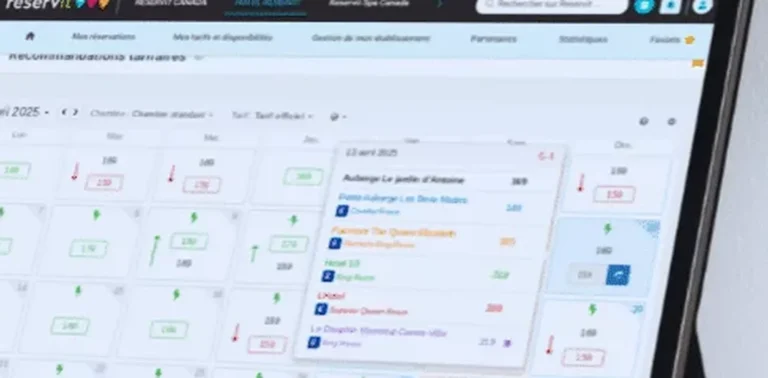
Data analysis and reporting tools play a crucial role in monitoring and continuously improving Yield Management strategies. They provide real-time insights into performance, allowing managers to make informed decisions based on accurate data. These tools help quickly identify revenue optimization opportunities and areas that need adjusting, making Yield Management strategies more responsive and effective.
Example : a hotel chain uses analysis tools to visualize key indicators, adjusting rates or launching targeted promotions to improve RevPAR and ADR.
These technological developments give you powerful ways to fine-tune your revenue management, adapting your offers and rates in real time to respond to fluctuating demand and guest preferences. By relying on these tools, you can not only maximize your revenue but also strengthen guest satisfaction and loyalty.
With an in-depth understanding of Yield Management fundamentals, combined with the integration of innovative technologies such as property management systems (PMS), artificial intelligence (AI) and data analysis tools, you can not only optimize your revenue but also improve the guest experience. The constant evolution of the tourism market calls for dynamic and responsive management strategies. By adopting data-driven approaches to make informed decisions, businesses can stay competitive in an increasingly saturated environment. Modern technologies offer powerful ways to analyze consumer behaviour, predict market trends and adjust offers in real time, enabling more precise and efficient management of prices and availability. To go further and turn your knowledge into concrete action, explore our personalized solutions and Yield Management strategies at Reservit. Discover how our technology and expertise can help you optimize your revenue and improve your guests’ experience.
Julie
Communication Manager
In partnership with Jennifer Therond

Article Revenue management
11 min read

Article Revenue management
4 min read

Article Revenue management
3 min read