Article Trends and market
Why consolidate all your reservations in a single tool?
3 min read
No result. Try another word, or request a demo.
Country and language
All other countries
Reservit 17 min read
Discover the levers that help you diversify your revenue all year round and stop enduring the low season.
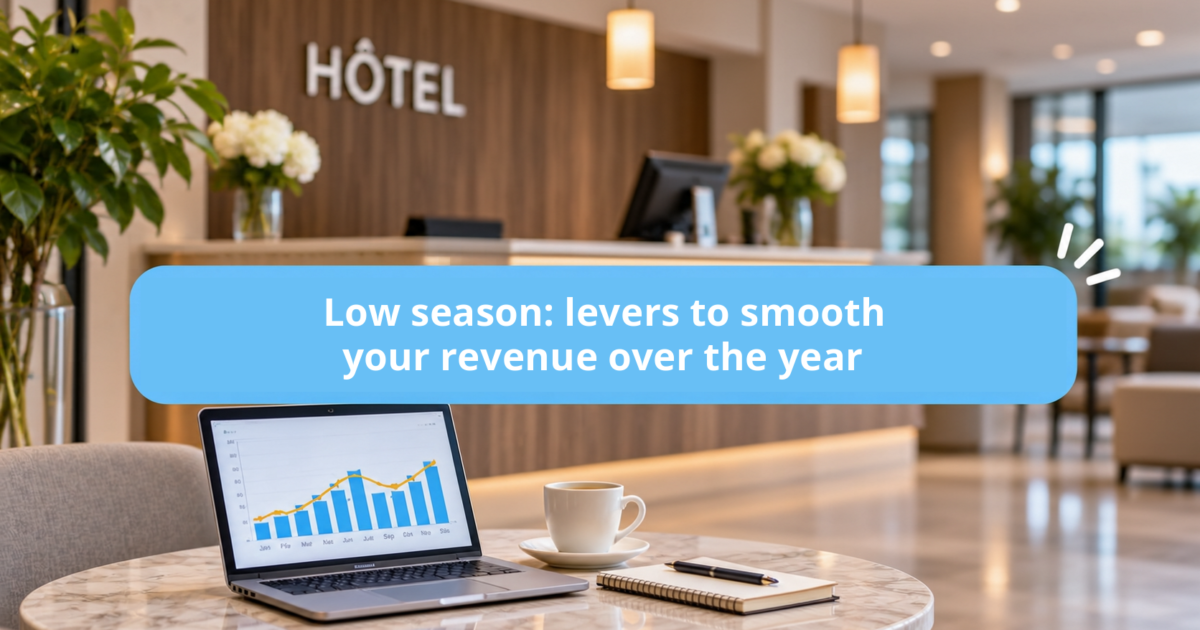
For a hotel in low season, it is often the same story: the booking calendar thins out, costs keep running, and the temptation is strong to cut prices or wait for things to pick up. This wait-and-see approach has a real cost: not just lost revenue, but wasted room for manoeuvre, guest profiles that pass by without stopping, and spaces and facilities that sit idle when they could be earning money. Smoothing your revenue over 12 months is not reserved for large chains with dedicated sales teams. It is within reach of any independent property willing to look beyond the room night: diversifying revenue streams, targeting guests whose travel calendar naturally matches the quiet periods, and equipping yourself with tools to anticipate demand rather than endure it. In this article, we review the practical levers (spaces to monetize, emerging profiles to attract, budget and cash flow management) so that low season stops being a problem to manage and becomes a period to steer.
The room night remains the core of the hotel business model, but relying on it alone leaves a significant share of a property’s potential untapped. The hotels that weather quiet periods best are rarely those with the lowest prices: they are the ones that have built several revenue streams that keep working even when the booking calendar is sparse. And in most cases, the resources to get there are already in place, just underused.
By nature, a hotel has spaces that stay empty for much of the day and the year: meeting rooms unused on weekdays, a deserted lobby in the morning, an empty terrace in the shoulder season, a restaurant closed at lunchtime out of season. These spaces are real estate that has already been paid for, and they can generate revenue without heavy investment if you rethink how they are used.
Day coworking is one of the most accessible options. Offering a day pass (guaranteed high-speed Wi-Fi, a desk or dedicated area, coffee included) to freelancers, remote workers or local nomads turns an underused lobby into a source of recurring revenue. This is not a renovation project: it is a priced offer, published on your website and on local coworking platforms, that captures demand already present in most cities and tourist destinations. Properties that take this step often notice an unexpected side effect: these day guests become ambassadors, and sometimes overnight guests on later trips.
Renting out spaces for non-tourism uses is another underexploited lever. A bright room, a well-kept garden, carefully designed interiors: these are exactly what professional photographers, content creators and local brands look for when organizing photo shoots or product launches. These rentals are arranged by the half-day or full day, without disrupting the core hotel business, and at hourly rates well above the value of an empty room. All it takes is letting local creative agencies, regional photographers and companies that hold internal events know that the space is available.
Events open to non-residents complete the picture. A hotel restaurant running at only 40% capacity in low season can become a local gathering place: a monthly themed dinner, a tasting evening with a local winemaker, a Sunday brunch open to all. These events generate F&B revenue, build local visibility and produce content for social media, often shared by the guests themselves. The average spend for a private event or a themed dinner is well above that of a standard room night, with controlled variable costs.
Travellers are no longer looking just for a bed: they are looking for a reason to come and something to experience. This expectation, well documented for several years now, is a direct opportunity for independent hotels. Their local roots, knowledge of the area and relationships with players in the destination give them an advantage that large chains cannot replicate. The challenge is to monetize it.
The basic model is simple: list local experiences (guided hikes, cooking workshops with a chef, a private winery tour, surf lessons, kayak outings) and earn a commission on every booking made through the hotel. With no extra infrastructure and no dedicated staff, the property becomes a gateway to what the destination has to offer and earns revenue every time a guest heads out on an excursion. Specialized platforms make it easier to connect with providers and manage commissions, but a direct agreement with a few trusted local providers is enough to get started.
The next level is the package. Rather than selling the room and the experience separately, both are combined into one coherent offer: a “wine tourism weekend” with accommodation, a cellar visit and a food and wine pairing dinner; a “trail running stay” with room nights, transfers to race starts, sports recovery and a hearty breakfast. These packages are not only sold on the hotel’s website: they find their audience on themed platforms, in niche newsletters or through specialized referrers. And they protect your pricing: in a €280 package for two, nobody tries to work out whether the room is worth €110 or €130 a night.
Some properties go further by developing their own branded products: homemade jam, honey from rooftop hives, coffee selected by the chef, preserves made from garden surplus. These products sell in an on-site shop, but also online or at local markets. Their margins are often excellent, they can be produced in low season when the team has time, and they strengthen the property’s identity in a way no rate offer can.
The subscription model has transformed entire industries (music, software, fitness) by generating predictable, recurring revenue instead of one-off transactions. Hospitality is beginning to explore this path, with results worth a closer look for properties that have facilities or spaces underused outside peak periods.
The local subscription is the most direct version. A hotel with a spa, a pool, a gym or a sauna can offer local residents monthly or annual access to these facilities at a lower price than a dedicated club would charge. For the hotel, it means steady revenue from facilities that were running at 30% capacity out of season. For local members, it is a nearby service without the constraints of a traditional gym contract. This model also builds a lasting bond with the local community, an asset for image and word of mouth that purely tourist-oriented properties do not have.
The hotel membership is a broader version of the same idea. Some properties offer an annual card that unlocks benefits (priority booking, a guaranteed preferential rate, invitations to private events, a restaurant discount) for a fixed fee. The card is sold to regulars, to local businesses for their teams or clients, and to associations. It generates immediate revenue at the point of sale, reduces dependence on OTAs for part of the repeat clientele, and creates a sense of belonging that encourages long-term loyalty.
For hotels that host digital nomads or remote workers, a monthly or weekly pass is a well-suited option: coworking access, a discount on stays of more than seven nights, included services (coffee, printer access, a secure locker). This type of offer responds directly to structural demand from hybrid workers looking for a pleasant setting for one- to four-week assignments, while boosting occupancy during usually quiet periods.
These new revenue streams do not replace a structured sales strategy; they complement it. For them to work, you also need to identify the right guest profiles and understand how to reach them at the right time.
Filling a hotel in low season is not just a matter of waiting for guests to show up. It means actively seeking out specific profiles whose travel habits structurally match the quiet periods: guests who travel not in spite of the low season, but because of it.
Business travellers and companies that organize seminars and retreats naturally follow a different calendar from leisure tourism. Training sessions, strategy meetings, team days and residential seminars are planned precisely outside peak season, because staff are available, rates are more negotiable and properties are less busy. Their interests align directly with the needs of hotels in low season.
To capture this clientele, the property must make its offer easy to find on the right channels. A well-equipped meeting room (projector, wired connection, sound system, natural light) is a prerequisite, but it is useless if it is not visible where organizers search. Platforms specializing in meeting venue bookings, local event agencies and HR managers at companies in the area are the contacts to target. A standard quote, a technical sheet for the room and a few professional photos are enough to start direct outreach to companies within a reasonable radius.
Meetings and retreats also generate significant additional revenue: catering (coffee breaks, group lunches, closing dinner), accommodation for participants travelling from afar, and sometimes team-building activities organized through local partners. The average spend per participant at a residential seminar is well above that of a typical leisure stay, and bookings are often made several weeks in advance, which secures the calendar and makes staff planning easier.
Groups are one of the most effective levers for smoothing revenue over the year, provided they are part of a proactive sales strategy rather than something you simply wait for. Family reunions, sports clubs at training camps, hiking clubs, school groups, seniors’ clubs: these requests come in all year round, with a strong concentration in the periods that individual travel neglects.
What sets groups apart is that they book early and block several rooms at once. A group booking signed three months ahead for a week in November is a guaranteed revenue floor that completely changes how you manage the period. It lets you adjust staffing, plan supplies and sell the remaining rooms with greater peace of mind. This predictability has real operational value, often underestimated when you think only in terms of nightly rate.
To develop group business, you need a dedicated offer: a clearly defined group rate, suitable cancellation terms, group dining options, and common areas available in the evening. This offer is promoted through specific channels (local associations, sports federations, tourist offices, professional networks) that differ from those used for individual travel. A property that has never worked this segment can often secure its first bookings simply by contacting associations and clubs in its area with a clear proposal.
The world of work has changed irreversibly since 2020. Partial or full remote work has become the norm for a significant share of the workforce, and some of these workers have turned this flexibility into a lifestyle: working from places chosen for their quality of life rather than their proximity to an office. There are an estimated 40 to 43 million digital nomads worldwide in 2026. Even though this figure covers very diverse profiles, it points to real, structural demand for accommodation suited to remote work.
The paradox is that only 2% of these nomads currently choose a hotel, compared with 44% who opt for Airbnb. Not out of inherent preference, but because hotel offers are generally not designed for them: nightly stays, no kitchen, no functional workspace, no weekly rates. Properties that remove these friction points capture a very profitable profile: stays of one to four weeks, on weekdays, during low-demand periods, with little price sensitivity if the environment meets their needs.
The bleisure traveller (a blend of business and leisure) follows a similar logic. This traveller goes on a business trip and extends the stay for personal tourism, or the other way round: goes on holiday and spends a few days working. Bleisure stays are getting longer, from two or three nights to five to seven days according to 2026 trends. For hoteliers, this profile values a good connection, a place to work, dining options nearby in the evening and some flexibility on check-in and check-out times. These are not heavy investments; it is a matter of the signals you send in your communication and your offer.
Finally, the slow traveller wants to settle in rather than sightsee. They want to understand an area, take time to adopt a local routine, and discover markets, artisans and hiking trails. They deliberately travel off-season to avoid crowds and find in that period exactly the destination they were looking for. This profile is particularly receptive to weekly or fortnightly offers, authentic local recommendations and properties that make them feel at home rather than in a hotel.
Activating these profiles is one thing. You also need the tools to anticipate quiet periods, build a consistent budget and manage demand over 12 months rather than reacting week by week.
Diversifying revenue and targeting the right profiles are effective strategies, provided they are implemented at the right time. Most low-season management mistakes do not come from a lack of ideas: they come from a lack of anticipation. Waiting until the calendar is empty to act is already too late. Smoothing revenue over the year means building a 12-month view and having the tools to adjust it continuously.
Most properties build their budget in a linear way (an annual figure split into two or three broad periods) without taking into account how each cost item actually behaves from month to month. This blind spot makes management difficult: when October results look poor, there is no way of knowing whether they really are, or whether the reference budget was poorly built.
A seasonal budget starts from the property’s actual history, month by month, over two or three years. It identifies the structurally weak months, the transition months and the peak months, and assigns to each period the costs that match how they really behave. Fixed costs (rent or loan repayments, insurance, subscriptions, permanent salaries) are spread evenly. Variable costs (laundry, guest amenities, food, seasonal staff, energy) are calibrated on the occupancy rate forecast for each month. Done seriously once, this work changes how you read monthly performance: a November at 40% occupancy can be a good month if the budget forecast 35%.
This seasonal budget also becomes an operational decision-making tool. It lets you schedule maintenance and renovation work during the quietest months, when the impact on guests is minimal, teams are available and contractors are easier to book. It identifies the months that need targeted sales action ahead of time. And it avoids the classic mistake of spending in September, when cash is at its highest after the summer, without setting money aside to cover the fixed costs of January and February.
Revenue and cash flow are two different realities, and low season is when this distinction becomes critical. A hotel can post positive revenue over the year while going through severe cash flow pressure between November and March, simply because payments come in over a few months while costs run all year.
The first answer is structural: make deposits at booking systematic. A confirmed booking without a deposit is a promise, not a payment. Requiring a deposit of 30 to 50% at confirmation, especially for off-season stays, groups and seminars, immediately improves your cash position and reduces the risk of no-shows. Non-refundable rate policies have the same effect: the money comes in at booking, not on arrival.
Negotiating supplier payment terms is a complementary lever that is often overlooked. A linen supplier, a maintenance contractor or a guest amenities distributor may accept deferred payment terms if the business relationship is solid and the request is made in advance. Aligning payment dates with the property’s revenue cycles (paying in September for what was delivered in June) automatically eases cash flow pressure in the shoulder season.
Finally, building a cash reserve during high season is a habit many properties keep putting off (there is always a good reason to invest when money is coming in). Setting aside the equivalent of two to three months of fixed costs in July or August, in a separate account, turns low season from a survival period into a normal management period. This cushion does not earn a return, but it avoids painful trade-offs between paying your bills or your staff in February.
A property that only looks at its booking calendar week by week is not managing its demand, it is enduring it. The difference between a hotelier who fills quiet periods and one who gets through them by cutting costs often comes down to a single factor: the ability to read demand signals early enough to act effectively.
The first tool is the pickup report built into the PMS: how many bookings were made this week for each future period, compared with the same week last year. Checked regularly, this report lets you spot very early that a period is filling more slowly than expected, and trigger targeted sales action 60 or 45 days out rather than 7 days out, when there is far more room for manoeuvre. A slightly adjusted rate, an offer sent to your guest database, a call to a local agency: these actions work when they are taken early. They work much less well when taken in a rush.
The local demand calendar is the second essential tool. Cultural events, marathons, trade fairs, festivals, school holidays by region, regional conferences: these events create predictable demand peaks that dynamic pricing must anticipate. A property that knows this calendar 12 months ahead never misses a demand-generating local event for lack of adjusting its rates in time. Conversely, it also identifies the structurally empty weeks that call for proactive action, without waiting for the calendar to speak for itself.
The Reservit PMS brings this data together and supports this kind of long-term management: booking history, pickup analysis, performance tracking by period and by channel. For an independent property without a dedicated revenue manager, having these indicators in one place, readable without technical expertise, fundamentally changes how pricing and sales decisions are made.
Smoothing your revenue over the year is not a matter of luck or a favourable location. It is the result of a deliberate strategy: diversified revenue streams that do not all depend on the room night, guest profiles identified and activated at the right time, and budget and pricing management that anticipates quiet periods rather than enduring them. For a hotel in low season, there is often more room for manoeuvre than it seems. An empty space can become a source of revenue. A traveller profile that is structurally available off-season is waiting for an offer that suits them. A dip spotted six weeks in advance can be managed; the same dip spotted 7 days out can only be endured. The difference between these two situations rarely comes down to the destination or the size of the property: it comes down to the tools and management habits in place. Reservit helps accommodation providers set up more structured and responsive management, whatever the size of the property. To find out how our PMS can help you manage your business over 12 months, see our accommodation offer.
Julie
Communication Manager
In partnership with Jennifer Therond
Article Trends and market
3 min read

Article Trends and market
12 min read

Article Trends and market
10 min read